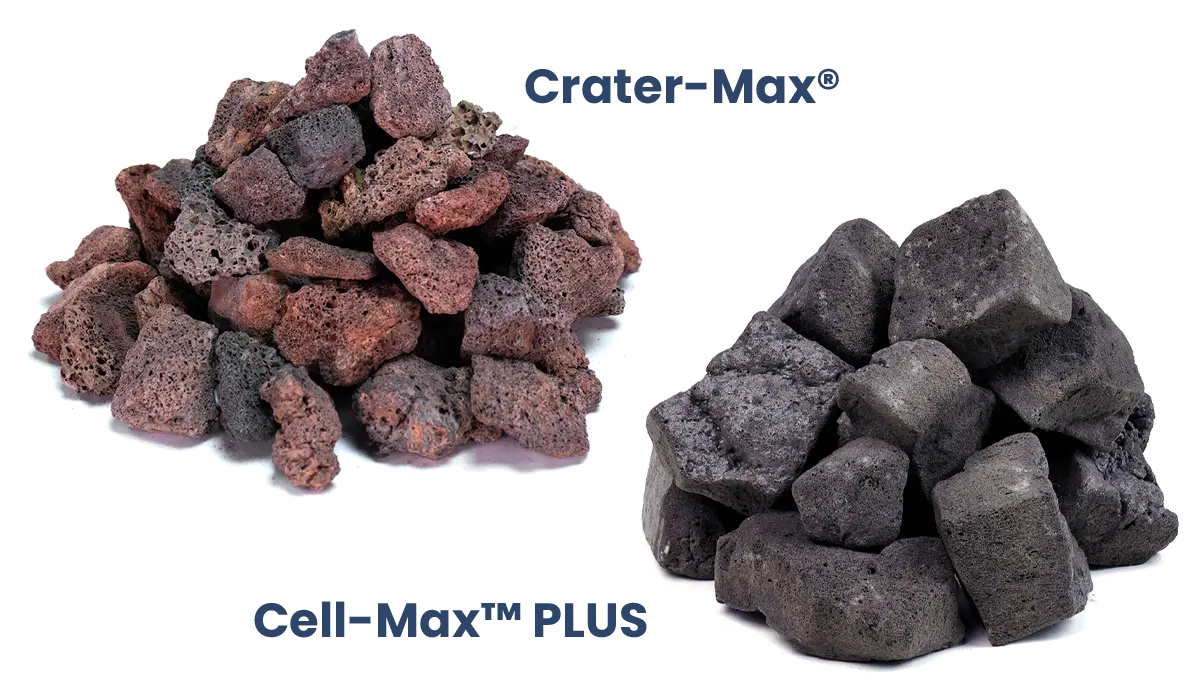
Rigid, breakdown-resistant media can provide a stable transition between the air-distribution floor and the primary treatment bed.
Gas-phase biofilters remove hydrogen sulfide, reduced sulfur compounds, volatile organic compounds, and other odor-causing contaminants by passing foul air through a porous media bed. Contaminants transfer from the air into a moisture film on the media and are subsequently oxidized by attached microorganisms.
Successful treatment depends on more than the biological properties of the upper media. The system must also maintain:
- Uniform airflow across the entire media bed
- Adequate open space for air passage
- Proper drainage of irrigation water and biological byproducts
- Stable media depth and bed geometry
- Controlled differential pressure
- Sufficient moisture and oxygen for microbial activity
Biofilter references have historically described upper organic media placed over a coarser support layer, including bark, wood chips, gravel, or porous lava rock. The support layer helps prevent finer media from entering the air-distribution system and provides a more open transition for airflow and drainage.
Crater-Max® and Cell-Max™ Plus (CMP) can perform this support function while also providing usable biological treatment capacity.
Purpose of the Base Support Layer
A properly designed base layer should perform several related functions.
Protect the Air-Distribution System
The base layer separates the primary treatment media from the underdrain, aeration floor, support grating, or air-distribution plenum. This reduces the potential for small media particles to fall into floor openings, ductwork, or drainage channels.
Improve Airflow Transition
Air entering a biofilter through floor openings or laterals initially has localized velocity. An open base layer provides a transition zone in which the air can spread laterally before entering the denser upper media.
The base layer does not correct a poorly designed floor or undersized air-distribution system. However, when combined with a properly engineered floor, it can help reduce localized high-velocity zones and support more uniform airflow through the treatment bed.
Promote Drainage
Irrigation water, condensation, and acidic biological byproducts must drain freely through the media. A coarse, noncompacting lower layer helps prevent water from collecting at the bottom of the bed.
Standing water can restrict airflow, increase differential pressure, create anaerobic areas, and reduce available treatment volume.
Support the Upper Media
The bottom layer distributes the weight of the upper treatment media and provides a stable working platform. A rigid base layer can reduce settlement and help maintain the specified treatment depth over the life of the system.
Provide Supplemental Biological Treatment
Unlike a nonporous gravel support layer, Crater-Max® and CMP provide surfaces on which biological films can develop. The lower layer can therefore contribute to contaminant removal rather than functioning only as inert structural fill.
Crater-Max® as a Base Layer
Crater-Max® is a porous mineral media intended for biological odor-control applications. Its irregular shape and internal porosity provide attachment surfaces for sulfur-oxidizing microorganisms.
Advantages
Crater-Max® offers several potential benefits when used beneath an upper biofilter media bed:
- Rigid mineral structure
- Resistance to decomposition
- Open void space for airflow and drainage
- Ability to support attached biological growth
- Suitability for acidic hydrogen sulfide applications
- Reduced settlement compared with organic support media
- Long service life when properly installed and maintained
Long-term wastewater odor-control studies have demonstrated that lava-rock-based biofilters can maintain biological odor treatment over extended operating periods. Porous lava rock has also historically been used as a support or treatment medium in municipal biofilter systems.
Limitations
Crater-Max® has a greater bulk density than CMP and most organic media. The increased dead load must be considered when evaluating:
- Existing concrete structures
- Elevated support floors
- FRP grating
- Underdrain systems
- Liner protection
- Transportation and installation costs
Its irregular particles may also require a separation screen when the upper media has a substantially smaller particle size.
Recommended Applications
Crater-Max® is particularly appropriate where:
- High hydrogen sulfide concentrations are expected near the inlet side of the bed
- A mineral support layer is preferred
- Structural capacity is adequate for the media weight
- Acid resistance and long-term dimensional stability are important
- Supplemental biological treatment to the primary media bed is desired
Cell-Max™ Plus as a Base Layer
CMP is an engineered porous media manufactured from recycled glass. It is lightweight, chemically inert, acid resistant, and designed to provide a stable structure for biological growth.
Typical CMP physical characteristics include:
- Dry bulk density of approximately 10.5 pounds per cubic foot
- Wet operating density of approximately 12.5 pounds per cubic foot
- High internal porosity
- Open particle structure
- Resistance to decomposition and compaction
- High surface area for microbial attachment
- Particle size generally ranging from approximately ¾ inch to 3 inches
Advantages
The principal advantage of CMP as a base layer is its combination of low weight and structural stability.
Compared with conventional mineral aggregate, CMP can substantially reduce:
- Dead load on the support floor
- Trucking weight
- Manual handling requirements
- Structural demands on existing biofilter cells
CMP also remains biologically active. When supplied with adequate moisture, nutrients, oxygen, and foul air, sulfur-oxidizing microorganisms can colonize the media and begin treating hydrogen sulfide in the lower portion of the bed.
Engineered glass media are used commercially in biological odor-control systems because they are inert, resistant to decomposition, and capable of supporting biological films.
Limitations
CMP is not intended to compensate for an inadequate support floor or an improperly designed airflow system. The supporting floor, grating, or screen must be compatible with the CMP particle size and must prevent the media from entering the air plenum.
CMP is also an inert medium. It does not inherently supply all nutrients required for long-term microbial activity. Where nutrient loading from the foul-air source is insufficient, supplemental nutrient addition may be required through the irrigation system.
Recommended Applications
CMP is particularly suitable where:
- Existing structural loading is limited
- A lightweight base layer is preferred
- Long-term resistance to decomposition is required
- An active hydrogen sulfide treatment layer is desired
- Uniform media depth and low settlement are priorities
- Freight weight or installation access is a concern
Comparison of Base-Layer Options
| Characteristic | Crater-Max® | Cell-Max™ Plus | Organic Wood or Bark | Conventional Gravel |
|---|---|---|---|---|
| Resistance to decomposition | Excellent | Excellent | Limited | Excellent |
| Relative weight | High | Low | Low to moderate | High |
| Biological attachment potential | High | High | High | Low to moderate |
| Acid resistance | Excellent | Excellent | Variable | Variable |
| Settlement potential | Low | Low | Moderate to high | Low |
| Moisture retention | Moderate | Moderate to high | High | Low |
| Airflow and drainage | Good | Good | Variable over time | Good |
| Supplemental treatment value | Yes | Yes | Yes | Limited |
| Replacement frequency | Low | Low | Higher | Low |
Recommended Layer Configurations
The final configuration should be based on airflow, contaminant loading, media depth, floor design, allowable structural loading, and required empty-bed residence time.
CMP Beneath Engineered Biofilter Media
A typical arrangement may include:
- Air-distribution floor or support system
- Approximately 12 to 24 inches of CMP
- Separation screen where required
- Upper Enhanced Cell-Max™ Plus, wood-based, bark-based, or blended treatment media
- Surface irrigation system
This arrangement provides a lightweight, stable support layer that also contributes to hydrogen sulfide treatment.
Crater-Max® Beneath Organic Media
A typical arrangement may include:
- Air-distribution floor
- Approximately 12 to 24 inches of Crater-Max®
- Separation screen or transition layer
- Upper wood-chip, bark, compost blend, or Fiber-Max™ media
- Surface irrigation system
This configuration can be beneficial when the upper organic media requires a rigid, freely draining foundation.
Combined Crater-Max® and CMP Base
For selected applications, the base section may use both products:
- Lower Crater-Max® layer for structural stability and drainage
- Upper CMP layer for reduced weight and increased biological surface area
- Primary upper media selected for the target odor compounds
This approach should only be used when the additional interface and media depth provide a clear process or structural benefit.
Design Considerations
Empty-Bed Residence Time (EBRT)
All media layers that receive foul air contribute to total bed volume and empty-bed residence time. However, the designer should not automatically assign the same treatment performance to every layer.
The expected removal contribution of the base layer depends on:
- Contaminant solubility
- Biological population
- Media moisture
- pH
- Nutrient availability
- Airflow distribution
- Loading rate
- Acclimation period
The primary treatment layer should therefore be sized to achieve the required performance without relying entirely on the base layer unless the complete layered system has been specifically evaluated.
Differential Pressure
Pressure loss through the clean media bed should be calculated using representative media data and the proposed face velocity. The design should also include allowance for:
- Biological growth
- Mineral accumulation
- Retained solids
- Media settlement
- Non-uniform irrigation
- Aging of the upper organic media
Physical characterization research has shown that changes in media structure, compaction, moisture, and retained solids can significantly increase pressure drop in gas-phase biofilters.
Differential-pressure monitoring ports should be provided across the complete bed and, where practical, across individual media layers.
Air-Distribution Floor
Neither Crater-Max® nor CMP should be installed directly over floor openings that are too large to retain the media.
The support system may consist of:
- HDPE air-distribution floor
- Corrosion-resistant FRP grating
- Engineered underdrain blocks
- Perforated duct or lateral systems
- Structural screen and support combination
The floor must be designed for the wet operating load of the entire media bed, maintenance personnel, and any applicable safety factor.
Separation Screen
A separation screen is recommended when:
- The upper media is significantly smaller than the base media
- Organic particles could migrate downward
- Removal of only the upper media may be required for maintenance
- Maintaining a defined interface is important
The screen must have sufficient open area to avoid becoming the controlling pressure-loss component.
Moisture and Drainage
The irrigation system should distribute water uniformly across the entire surface. Irrigation should maintain the biological moisture film without creating continuous flooding at the bottom of the bed.
Drainage provisions should allow removal of:
- Excess irrigation water
- Condensate
- Suspended solids
- Sulfuric acid generated during hydrogen sulfide oxidation
- Dissolved mineral deposits
Installation
Recommended installation practices include:
- Inspecting and cleaning the air-distribution floor before placement
- Confirming all drainage openings are functional
- Installing media without mechanical compaction
- Limiting equipment traffic over the media
- Maintaining uniform depth throughout the cell
- Protecting liners and floor components during placement
- Installing separation screen flat and without excessive overlap
- Wetting the media uniformly before biological startup
- Performing an airflow-distribution or smoke test at specified installation stages
Performance Verification
A layered biofilter should be commissioned using a combination of physical and biological testing.
Recommended verification includes:
- Inspection of the support floor and drainage system before media installation.
- Smoke testing of the exposed air-distribution floor.
- Smoke testing after placement of the base layer.
- Confirmation of final media depths.
- Measurement of initial differential pressure.
- Verification of surface irrigation coverage.
- Biological acclimation using continuous foul air.
- Inlet and outlet odor-compound testing after the required startup period.
Smoke testing after placement of the base layer is particularly useful because it allows airflow deficiencies to be identified before the upper treatment media is installed.
Benefits of Using an Engineered Base Layer
When properly designed, Crater-Max® or CMP can provide the following advantages over conventional base materials:
- Long-term resistance to decomposition
- Reduced media settlement
- Improved drainage
- Stable airflow pathways
- Distribution floor protection
- Supplemental biological treatment
- Easier separation of upper and lower media layers
- Reduced replacement of the entire media bed
- Greater consistency than variable natural organic support materials
CMP provides the additional benefit of low structural weight, while Crater-Max® provides the rigidity and field history associated with porous mineral media.
Limitations and Engineering Cautions
Crater-Max® and CMP should not be represented as universal solutions for all biofilter systems.
Project-specific engineering is required when:
- Existing support-floor capacity is unknown
- Air velocity is unusually high
- Fine solids or grease are present in the foul-air stream
- Irrigation water contains high mineral concentrations
- The system operates at very low pH
- Media depth is limited
- The existing air-distribution system is non-uniform
- The upper media has a substantially different particle size
- Access for future media removal is restricted
The use of a durable base layer can improve system reliability, but biological performance still depends on appropriate residence time, loading, moisture, pH, nutrients, temperature, and airflow distribution.
Conclusion
Crater-Max® and Cell-Max™ Plus can serve as effective lower support and preliminary treatment layers in municipal and industrial biofilters.
- Crater-Max® is most appropriate where a durable porous mineral layer is desired and the structure can accommodate its greater weight.
- CMP is advantageous where low weight, high porosity, acid resistance, and long-term dimensional stability are priorities.
Both products offer advantages over decomposable organic support layers and nonbiologically active conventional aggregate. When combined with a properly designed air-distribution floor, separation screen, upper treatment media, drainage system, and irrigation system, these media can improve the structural and operational reliability of a layered biofilter.
Final media selection and depth should be based on project-specific contaminant loading, airflow, required treatment efficiency, structural limitations, and lifecycle objectives.