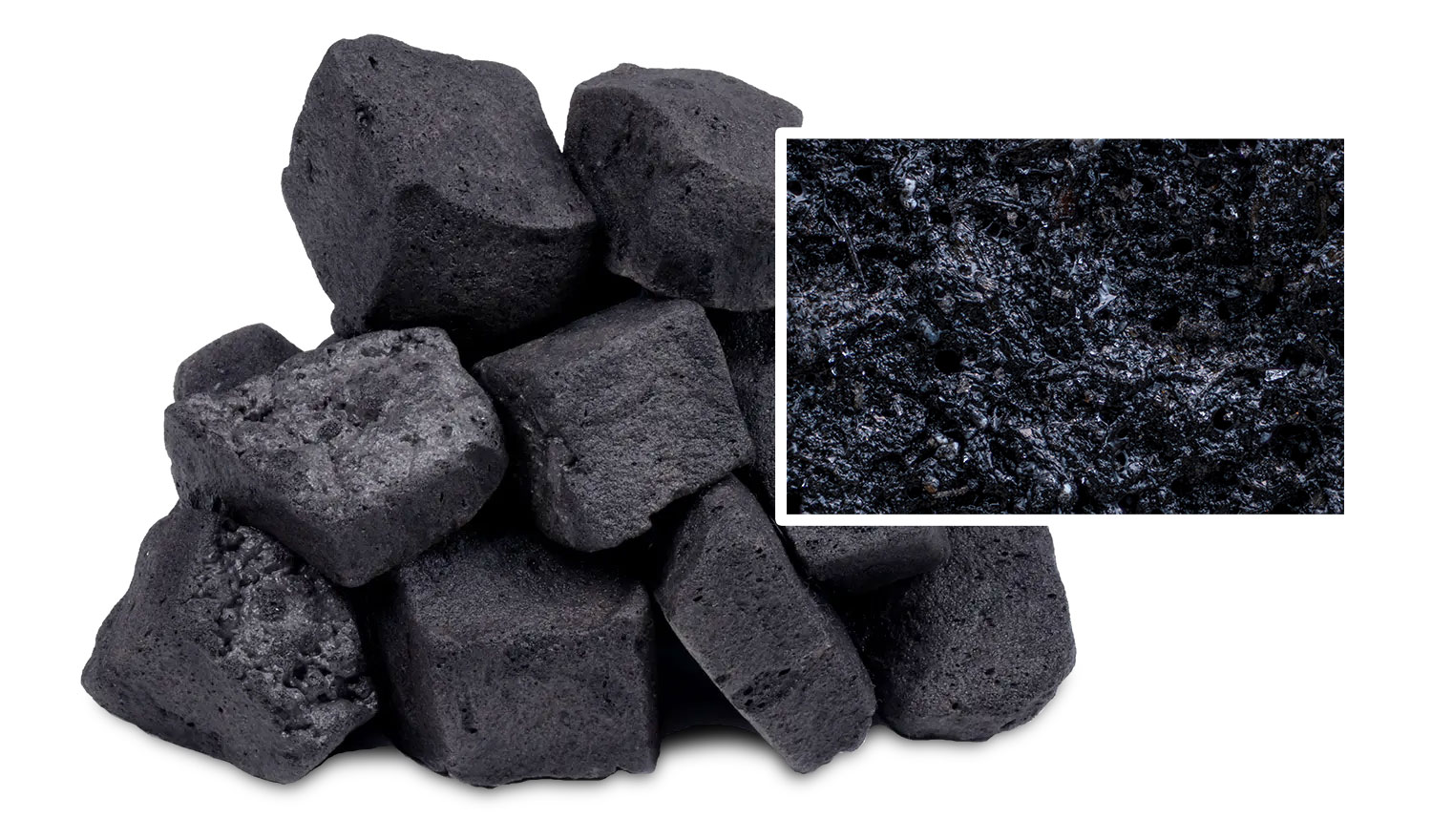
Enhanced Cell-Max™ Plus optimizes microbial colonization, mass transfer, and long-term structural stability. The inset shows a microscopic view of the nutrient-rich coating.
Biological air treatment systems are widely employed in wastewater treatment facilities to control odorous compounds generated from sewage handling processes. Biofilters provide a sustainable, energy-efficient, and cost-effective approach for the treatment of hydrogen sulfide (H2S), sulfur compounds, amines, and volatile organic compounds (VOCs). Odor removal is achieved through microbial oxidation rather than chemical neutralization, resulting in benign end products such as carbon dioxide, water, sulfate, and biomass.
The performance and longevity of biofilter systems depend on proper media selection, microbial ecology, airflow management, and operating conditions that support both system startup and long-term steady-state operation. Enhanced Cell-Max™ Plus (ECMP) is an engineered inorganic biofilter media developed by GES Biotek, LLC to optimize microbial colonization, mass transfer, and long-term structural stability.
Biofilter Treatment Mechanism
Wastewater biofilters operate by drawing odorous air through a porous bed of media that supports a biologically active biofilm. Odorous compounds dissolve into a thin water film that coats the media surface and are metabolized by microorganisms as energy and carbon sources.
Microbial Ecology and Biofilm Development
Biofilter performance is governed by microbial ecology within the media bed. A diverse and dynamic biofilm develops on the media surface consisting primarily of bacteria and fungi.
Two primary functional microbial groups dominate wastewater biofilters:
- Heterotrophic microorganisms, which require organic carbon, and
- Autotrophic microorganisms, which derive energy from inorganic compounds and assimilate carbon from carbon dioxide.
Startup Phase: Heterotrophic-Dominated Operation
During startup and early operation, rapid microbial colonization is critical to achieving stable odor removal performance. The proprietary coating applied to Enhanced Cell-Max™ Plus media is engineered to support heterotrophic organisms by providing readily available organic carbon and nutrients.
Consumption of the ECMP Coating and Functional Transition to Cell-Max™ Plus (CMP) Media
The ECMP coating is designed as a sacrificial, biologically available layer and is intentionally consumed as the colony grows. As microbial activity increases, the coating is progressively metabolized. This consumption represents successful biological establishment rather than media degradation.
As the coating is consumed by microbial colonization, the Cell-Max™ Plus underlying inorganic substrate remains structurally intact and continues to provide high surface area, void space, chemical inertness, and long-term durability.
Steady-State Operation: Autotrophic-Dominated Performance
During steady-state operation, autotrophic sulfur-oxidizing bacteria drive hydrogen sulfide oxidation. The inorganic CMP media provides an ideal long-term substrate resistant to acidic byproducts.
Key Scientific Principles
- Microbial Metabolism: Odorous compounds dissolve into the water film and are metabolized.
- Biofilm Ecology: The biofilm undergoes continuous growth and decay cycles.
- Mass Transfer: High surface area and porosity optimize pollutant transfer.
Effective odor removal depends on the efficient transfer of contaminants from the gas phase into the liquid film on the media surface and subsequently into the microbial biofilm. This process requires high media porosity, uniform airflow distribution, and sufficient surface area.
Enhanced Cell-Max™ Plus provides exceptionally high specific surface area 49,000,000 m2/m3 (14,935,200 ft2/ft3), optimizing gas-to-liquid mass transfer and increasing contact between pollutants and the biologically active water film.
The proprietary organic microfilm applied to Enhanced Cell-Max™ Plus further enhances mass transfer performance during startup by supplying readily available carbon and nutrients that promote rapid microbial attachment and biofilm development. This accelerates the formation of colony-forming units (CFUs) and improves early-stage pollutant consumption efficiency. As the coating is progressively consumed, the established biomass assumes full biological function, forming a dynamic cycle of microbial growth, decay, and consumption. Each cycle selectively favors microbial populations best suited to the prevailing contaminant loading and operating conditions.
Over time, the coating is intentionally consumed as part of normal biological operation; however, the underlying inorganic media kernel remains structurally stable and continues to provide permanent surface area for sustained microbial attachment and long-term mass transfer efficiency.
System Components and Design Factors
- Filter Media: ECMP and CMP provide surface area, moisture retention, and durability.
- Temperature and Moisture: Optimal microbial activity occurs between 20° – 40° C.
- Contact Time: Adequate EBRT improves removal efficiency.
- Airflow: Induced-draft airflow preserves void space (70 – 80%).
Conclusion
Enhanced Cell-Max™ Plus media supports rapid startup and long-term odor control through engineered microbial succession. The intentional consumption of the ECMP coating and transition to CMP media represents biological maturation, enabling a stable, self-sustaining odor control system.
Frequently Asked Questions
1. What is the coating on ECMP media?
The coating is a biodegradable nutrient layer designed to accelerate microbial establishment during startup. It is not structural and is not the media itself.
2. Why is the coating used?
The coating provides readily available organic nutrients that promote rapid biofilm formation and stabilize early odor removal.
3. Why does the coating fade?
The coating is intentionally consumed by microorganisms as food. Its disappearance indicates successful biological establishment.
4. Does coating loss mean the media is wearing out?
No. The coating is always present and deep within the pore structure. The permanent CMP inorganic media remains fully intact and functional.
5. What remains after the coating is consumed?
The CMP media core provides long-term surface area, airflow stability, and resistance to acidic byproducts.
6. Is re-coating required?
No. Once established, the biofilter is sustained by contaminants in the airstream such as hydrogen sulfide.
7. What organisms dominate long-term?
Autotrophic sulfur-oxidizing bacteria such as Thiobacillus species dominate steady-state operation.
8. Is coating consumption good?
Yes. It confirms proper startup and biological maturation.
9. How long does the media last?
CMP media is designed for long-term service, often decades.
10. What is the key takeaway?
The coating is temporary food. The remaining CMP media is the long-term solution.