One cubic foot is the volume of a space measuring 1 foot long, 1 foot wide, and 1 foot deep. In a biofilter, cubic feet describe the quantity of installed bulk media, feet describe bed depth or another length, and square feet describe the bed footprint. Keeping these units distinct is essential when calculating media quantity, residence time, and structural loading.
Length Area Volume and Loading
| Quantity | Unit | Typical Biofilter Use |
|---|---|---|
| Length or depth | ft | Bed depth or basin dimension |
| Area | ft2 | Usable bed footprint |
| Volume | ft3 | Installed bulk media quantity |
| Bulk density or unit weight | lb/ft3 | Weight per cubic foot of media |
| Average support load | lb/ft2 | Media load per square foot of bed |
There is no fixed conversion from cubic feet to linear feet. A length can be calculated from a volume only when the other dimensions are known. The three dimensions are multiplied to calculate volume.
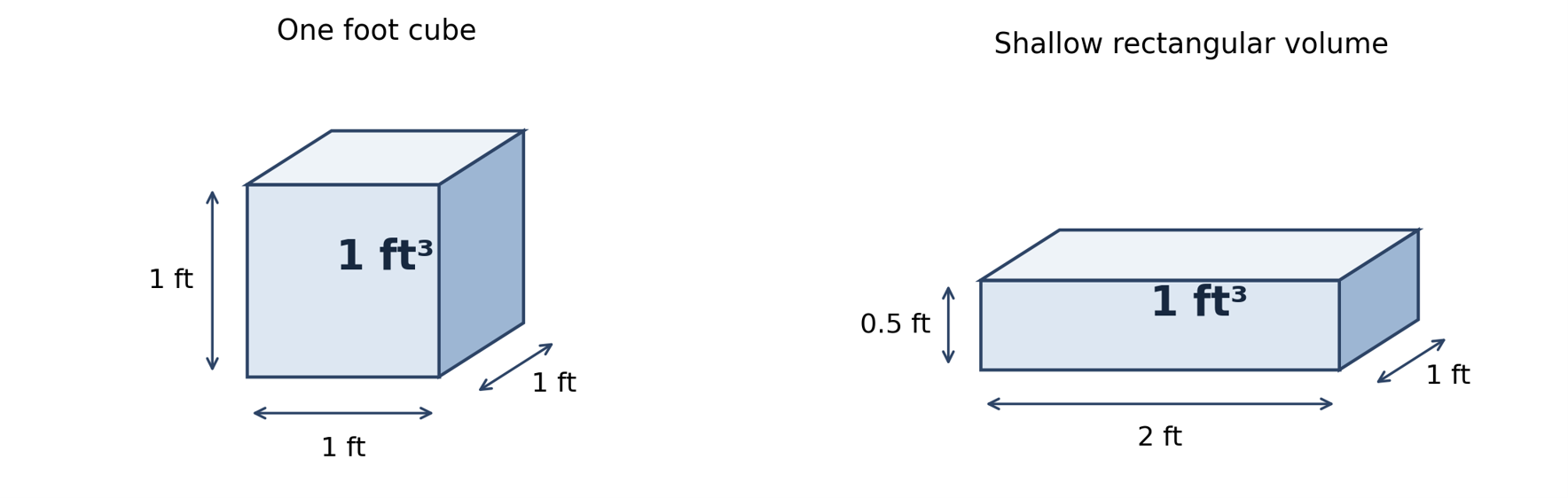
Figure 1. Both shapes contain 1 ft3 even though their dimensions differ
For installed media, bulk volume includes the media particles and the spaces between them. Particle porosity or bed void space does not replace the geometric volume used to order media or calculate empty bed residence time.
Calculating Installed Media Volume
Use the inside dimensions of the usable media bed. Convert inches to feet before multiplying. For a rectangular bed, calculate the footprint area A from length L and width W, then multiply by installed media depth d.1
A = L × W V = A × d = L × W × d
With dimensions in feet, A is in ft2 and V is in ft3. For a circular bed of inside diameter D, use V = 0.785398 × D2 × d. Measure media depth above the support screen; exclude the air plenum, support floor thickness, and freeboard.
Worked Geometry Examples
| Bed Geometry | Media Depth | Bed Area | Media Volume |
|---|---|---|---|
| 30 ft × 20 ft rectangular bed | 4 ft | 600 ft2 | 2,400 ft3 |
| 11 ft × 13 ft 6 in rectangular bed | 4 ft | 148.5 ft2 | 594 ft3 |
| 20 ft inside diameter circular bed | 4 ft | 314.16 ft2 | 1,256.64 ft3 |
In the second example, 13 ft 6 in equals 13.5 ft. It does not equal 13.6 ft. Circular results are rounded; use unrounded values during intermediate calculations.
Media Depth and Separate Layers
On a 600 ft2 footprint, each additional foot of media depth requires 600 ft3. A 2.5 ft lower layer requires 1,500 ft3, and a 1.5 ft upper layer requires 900 ft3. Together they provide 2,400 ft3 at a total depth of 4 ft. Calculate each layer separately when products, prices, or densities differ.
Volume Conversions
| Conversion | Equivalent Quantity |
|---|---|
| 1 cubic foot | 1,728 cubic inches |
| 1 cubic yard | 27 cubic feet |
| 1 cubic foot | 0.02831685 cubic meter |
| 1 cubic meter | 35.3147 cubic feet |
| 1 cubic foot | 28.3168 liters |
| 1 cubic foot | 7.48052 US liquid gallons |
Metric and liquid-volume values are rounded from NIST conversion factors.2 The gallon equivalent describes geometric capacity; it does not represent the amount of water retained by one cubic foot of media.
For purchasing, 2,400 ft3 equals 88.89 yd3. If an approved package contains 50 ft3, the nominal requirement is 48 packages before any project allowance. Confirm package volume, handling losses, and the installed-depth acceptance basis with GES before ordering.
Converting Media Volume to Weight and Support Load
Bulk density states how many pounds are associated with one cubic foot of media under a defined moisture condition. Total weight T equals bulk density ρ multiplied by volume V. Average media load q on the bed footprint equals bulk density multiplied by media depth d.
T = ρ × V q = ρ × d
Use ρ in lb/ft3, V in ft3, and d in ft. The results are T in lb and q in lb/ft2. At a depth of exactly 1 ft, density and average load have the same numerical value, but their units and physical meanings remain different.
GES Laboratory Tested Bulk Densities
The following GES-reported values are reproduced from the current CMP and ECMP technical paper. They are weights per cubic foot of bulk media, not loads per square foot of support area.3
| Media Condition | CMP | ECMP |
|---|---|---|
| Dry | 11 lb/ft3 | 11.5 lb/ft3 |
| Operating Wet | 13 lb/ft3 | 14.5 lb/ft3 |
| Volume | 45 lb/ft3 | 43 lb/ft3 |
CMP means Cell-Max™ Plus. ECMP means Enhanced Cell-Max™ Plus. Dry values apply before wetting. Operating wet values represent irrigated operation. Fully flooded values include the tested media and contained water under the flooded condition.
Fully Flooded Media Load by Bed Depth
| Media Depth | CMP at 45 lb/ft3 | ECMP at 43 lb/ft3 |
|---|---|---|
| 1 ft | 45 lb/ft2 | 43 lb/ft2 |
| 2 ft | 90 lb/ft2 | 86 lb/ft2 |
| 31 ft | 135 lb/ft2 | 129 lb/ft2 |
| 4 ft | 180 lb/ft2 | 172 lb/ft2 |
| 5 ft | 225 lb/ft2 | 215 lb/ft2 |
For 2,400 ft3 of ECMP over 600 ft2 at a 4 ft depth, operating wet weight is 34,800 lb and average load is 58 lb/ft2. Using the reported fully flooded value, weight is 103,200 lb and average load is 172 lb/ft2. The media volume remains 2,400 ft3 in both calculations.
For structural design, confirm the approved product grade and required design unit weight. A project maximum can exceed the tested sample value. Include floor, screen, equipment, live loads, and free water above or outside the media separately. Do not add the water already included in a fully flooded media value a second time. The values above are average media loads; the engineer must assess actual support reactions and applicable load combinations.
Using Media Volume in Biofilter Design
Empty bed residence time, or EBRT, is the bulk media volume divided by airflow. When V is in ft3 and Q is actual cubic feet per minute at the bed operating conditions, multiply by 60 to obtain seconds. The EPA describes the same volume-to-flow relationship as empty bed contact time.4
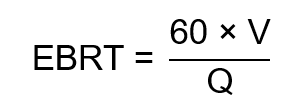
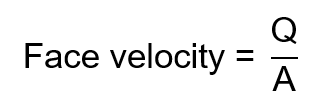
For the 30 ft × 20 ft bed with 4 ft of media, V is 2,400 ft3 and A is 600 ft2. At 4,800 acfm, EBRT is 30 seconds and face velocity is 8 ft/min. If airflow increases to 6,000 acfm, EBRT falls to 24 seconds while media volume remains unchanged.
EBRT uses the full bulk bed volume. Actual gas residence time depends on connected gas-filled space, moisture, and airflow distribution. Verify any required target EBRT against the contaminant loading and outlet requirements; the examples here demonstrate unit calculations and do not establish treatment performance.
Two Layer Calculation Example
On the same 600 ft2 footprint, install 2 ft of CMP below 2 ft of ECMP. Each layer contains 1,200 ft3. With the full 4,800 acfm passing sequentially through both layers, each layer has a nominal EBRT of 15 seconds, for a total of 30 seconds.
| Load Condition | CMP Lower Layer | ECMP Upper Layer | Combined Load |
|---|---|---|---|
| Operating Wet | 26 lb/ft2 | 29 lb/ft2 | 55 lb/ft2 |
| Fully Flooded | 90 lb/ft2 | 86 lb/ft2 | 176 lb/ft2 |
The calculated total media weight is 33,000 lb operating wet and 105,600 lb fully flooded. Each layer contributes its own density multiplied by its own depth. The support floor carries the combined load, subject to the actual support configuration.
Checks for Drawings, Proposals, and Submittals
- State installed media quantity in ft3 and media depth in ft.
- State laboratory weight or bulk density in lb/ft3.
- State calculated support loading in lb/ft2 and identify the depth and moisture condition.
- Keep airflow in acfm consistent with the operating temperature and pressure.
- Use the usable media footprint rather than the outside basin dimensions.
Technical References
- NIST. Circumference Area and Volume. Geometric area and volume formulas. Accessed October 2 2026. Source
- NIST. Guide to the SI Appendix B9. Conversion factors for length and volume. Accessed October 2 2026. Source
- GES Biotek. CMP vs ECMP White Paper. Current revision October 2 2026. Page 3 media properties and laboratory-tested bulk densities. Source
- US EPA. Off-Gas Treatment Technologies for Soil Vapor Extraction Systems State of the Practice. EPA 542 R 05 028 March 2006. Section 5.1 pages 5-2 and 5-3. Source
Online references accessed October 2, 2026. Renderings illustrate representative configurations and do not establish dimensions or performance.